Artwork · c. 1503–1519
Mona Lisa by Leonardo da Vinci: Who She Was and Why She Is Famous
- Artist
- Leonardo da Vinci
- Date
- c. 1503–1519
- Medium
- Oil on poplar panel
- Dimensions
- 77 × 53 cm
- Collection
- Musée du Louvre, Paris
- Movement
- Renaissance
- Medium guide
- Oil painting
Who she was
The sitter is generally identified as Lisa Gherardini, born in Florence in 1479 and married to the silk merchant Francesco del Giocondo. The 16th-century biographer Giorgio Vasari wrote that Leonardo painted her portrait for Francesco, and a note written in 1503 by a Florentine official, discovered in a library book in 2005, confirms that Leonardo was working on a portrait of “Lisa del Giocondo” that year. Her married name gives the painting its other titles: La Gioconda in Italian, La Joconde in French. “Mona” is a shortened form of madonna, “my lady.”
How Leonardo painted it
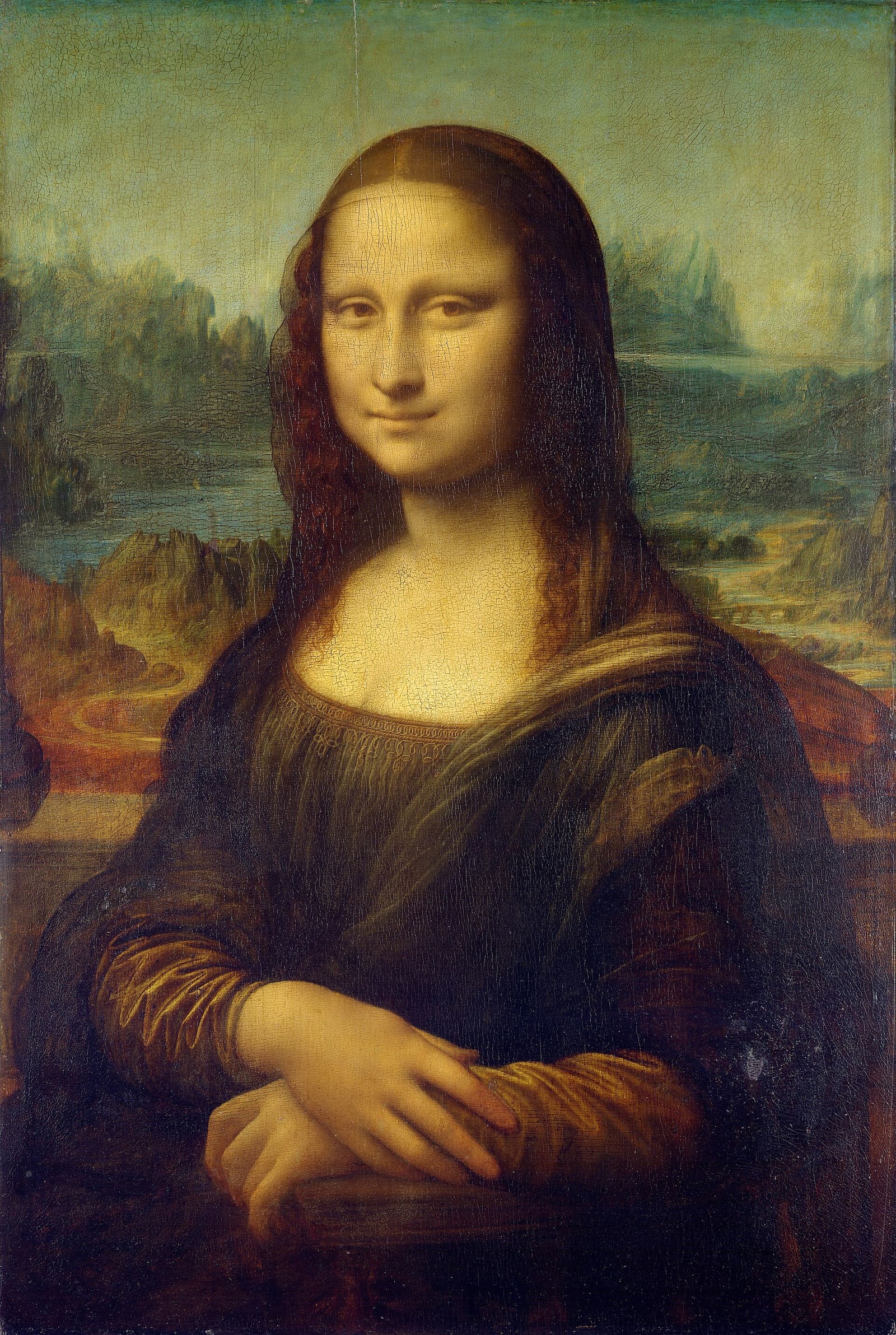
Leonardo da Vinci painted on a thin panel of poplar wood, building the face out of many transparent layers of oil glaze, some barely thicker than a hair. The result is the technique called sfumato, from the Italian for “smoke”: there are no hard outlines, and the edges of the eyes and mouth melt into shadow. Because the corners of the mouth are left soft, the expression seems to shift as you look, which is the source of the famous smile.
Behind her stretches an imaginary landscape of winding roads, a bridge, rocky peaks and water, fading into blue haze. Look closely and the horizon on the left sits lower than the one on the right, one reason the figure seems so alive against it.
A portrait that was never delivered
Leonardo seems never to have handed the portrait over. He kept working on it for years, and took it with him when he moved to France in 1516 at the invitation of King Francis I. After his death in 1519 it entered the French royal collection. It hung at Fontainebleau and Versailles, and after the French Revolution it went to the new public museum at the Louvre, apart from a few years when Napoleon kept it in his bedroom.
The 1911 theft and modern fame
On 21 August 1911 a Louvre handyman, Vincenzo Peruggia, walked out of the museum with the painting under his smock. It was missing for more than two years before he tried to sell it in Florence. The theft turned a celebrated old master into a global celebrity. Read the full story in The Day the Mona Lisa Was Stolen.
Since then the painting has been attacked several times, with acid, a thrown stone, and in recent years cake and soup, which is why it now sits behind bulletproof glass.
Where to see it
The Mona Lisa hangs in the Salle des États of the Louvre, facing Veronese’s vast Wedding Feast at Cana. It is part of the story of the Renaissance, and it repays the slow looking described in our guide on how to look at a painting, even through the crowds.
More works by Leonardo da Vinci
- The Last Supper · c. 1495–1498
Frequently asked questions
Who is the woman in the Mona Lisa?
Almost certainly Lisa Gherardini, the wife of the Florentine silk merchant Francesco del Giocondo. That is why the painting is also called La Gioconda in Italian and La Joconde in French.
Where is the Mona Lisa?
In the Musée du Louvre in Paris, where it hangs behind protective glass in the Salle des États. It has belonged to the French state since the Revolution.
How big is the Mona Lisa?
77 × 53 cm, about 30 × 21 inches. Visitors are often surprised by how small it is.
Why is the Mona Lisa so famous?
It was admired from the start for its lifelike subtlety, but its fame exploded after it was stolen from the Louvre in 1911. Two years of newspaper coverage made it a household image around the world.