Artwork · 1863
Olympia by Édouard Manet: Why It Shocked Paris
- Artist
- Édouard Manet
- Date
- 1863
- Medium
- Oil on canvas
- Dimensions
- 130.5 × 190 cm
- Collection
- Musée d'Orsay, Paris
- Movement
- Realism
- Medium guide
- Oil painting
What the painting shows
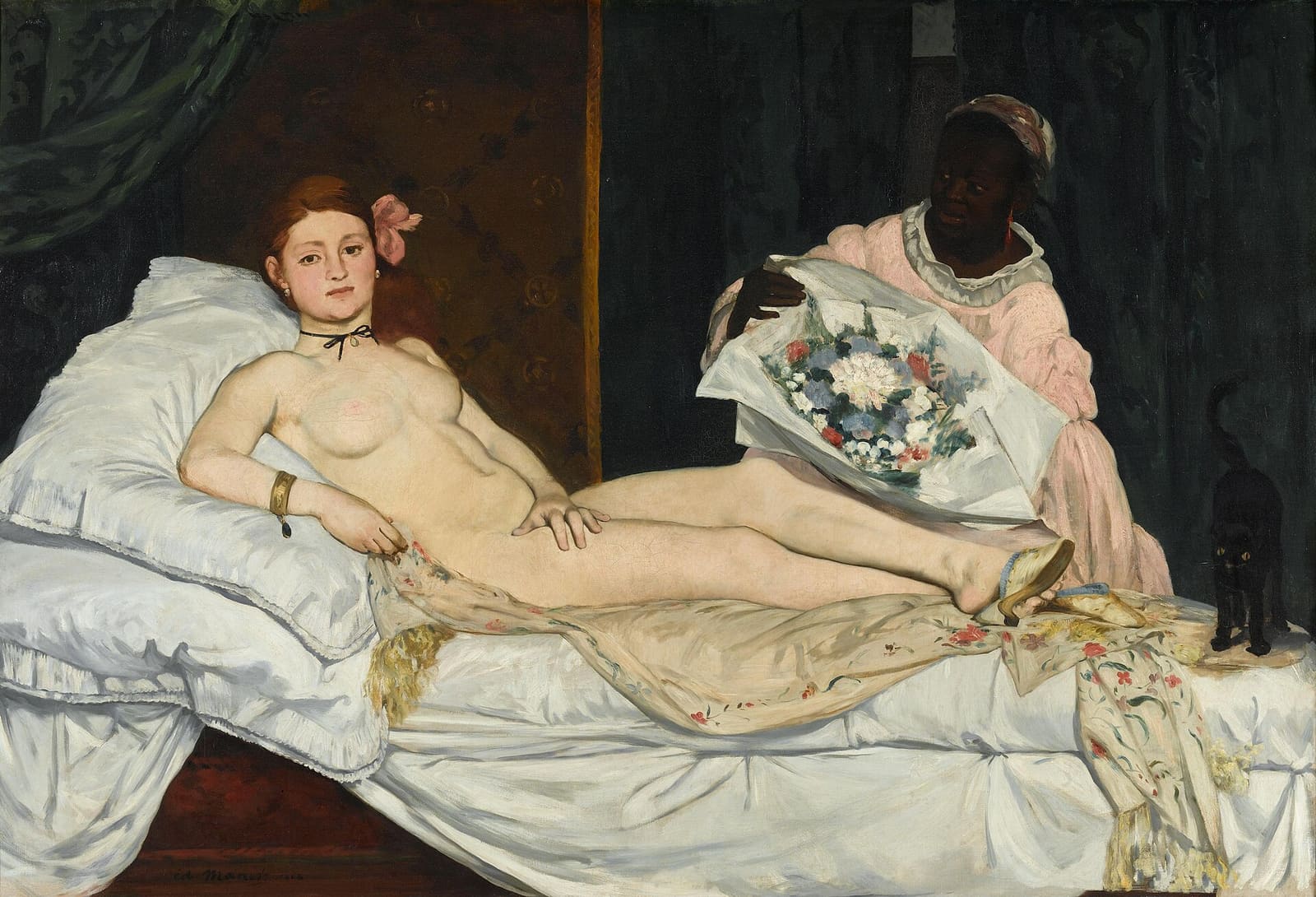
A young woman lies naked on a bed of white sheets and cushions. She wears an orchid in her hair, a black ribbon at her throat, a gold bracelet and a single slipper; the other has dropped off. Her hand rests firmly over her thigh. Behind her, a Black maid brings a large bouquet, evidently from a client. At the foot of the bed a black cat arches its back. And the woman looks straight out at us, coolly, as if we were the next visitor.
Rewriting Titian
Manet based the composition on Titian’s Venus of Urbino (1538), one of the most admired nudes in Western art. Everything that made Titian’s picture acceptable he changed. The goddess became a modern woman with a name, “Olympia,” that Parisians associated with courtesans. The sleeping lapdog, a symbol of faithfulness, became a hissing black cat. The soft, glowing flesh became flat and pale, outlined sharply against the white bed with little traditional modeling.
The models
Olympia was painted from Victorine Meurent, a young model who also posed for Manet’s Le Déjeuner sur l’herbe. She later trained as an artist and exhibited her own paintings at the Salon. The maid was modeled by a woman Manet’s notes call Laure, who lived nearby in Paris; in recent years exhibitions have given her a central place in the story of the painting.
Scandal at the 1865 Salon
Manet painted Olympia in 1863 but waited two years to show it. When it was accepted for the Salon of 1865, visitors jeered and critics attacked it as indecent, ugly and badly painted. Guards were posted to protect the canvas, and it was finally rehung high above a doorway, out of reach. It made Manet the most notorious painter in Paris. The story of this and other uproars is told in Paintings That Caused Scandals.
From scandal to masterpiece
Manet never sold the painting. After his death, in 1890, Claude Monet organized a public subscription to buy it from his widow and present it to the French state. It hung in the Musée du Luxembourg, then entered the Louvre in 1907, and moved to the Musée d’Orsay when the museum opened in 1986. Today it is seen as a founding image of modern art and of urban Realism.
Frequently asked questions
Why was Olympia so controversial?
Because it showed not a goddess but a recognizably modern Parisian courtesan, naked and looking straight at the viewer without shame. Nudes were accepted in art only when disguised as myth or history; Manet removed the disguise.
Who posed for Olympia?
Victorine Meurent, Manet's favorite model, who also posed for Le Déjeuner sur l'herbe and later became a painter herself, exhibiting at the Salon. The maid was modeled by a Black woman Manet recorded in his notes as Laure.
What painting is Olympia based on?
Titian's Venus of Urbino (1538), in the Uffizi in Florence, which Manet had copied as a young man. He kept the composition but replaced Titian's sleeping dog, a symbol of fidelity, with a black cat.