Artwork · c. 1508–1512
The Creation of Adam by Michelangelo: The Sistine Chapel Fresco
- Artist
- Michelangelo
- Date
- c. 1508–1512
- Medium
- Fresco
- Dimensions
- 280 × 570 cm
- Movement
- Renaissance
The scene
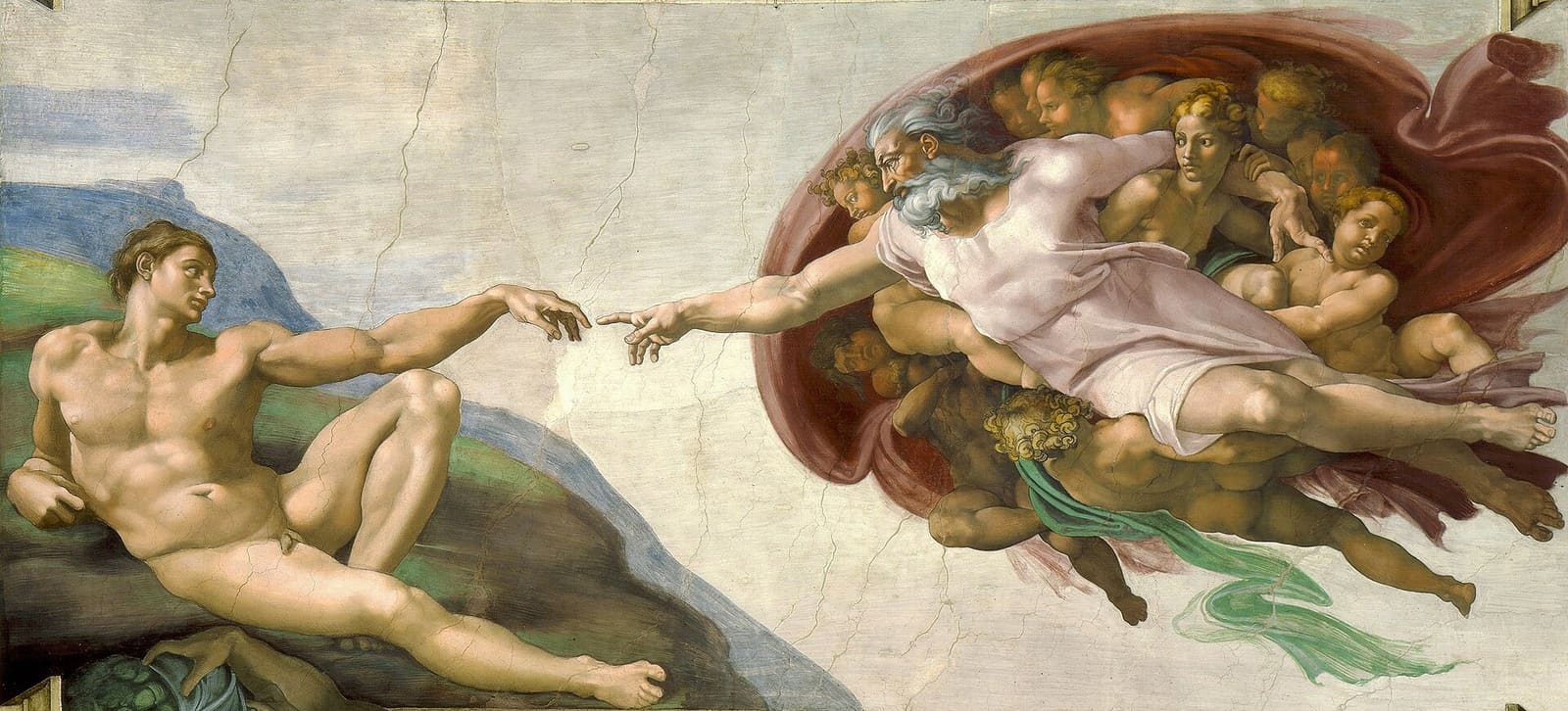
The Creation of Adam tells the moment in the Book of Genesis when God gives life to the first man. Adam lies on a bare green slope, his body complete but his arm hanging limp, waiting. God sweeps toward him through the air, wrapped in a great red cloak crowded with wingless angels, and stretches out his arm. Their index fingers do not touch. The small gap between them, the instant before life passes from one to the other, has made this one of the most copied images in Western art.
Under God’s left arm is a young woman who looks toward Adam; she is often read as Eve, not yet created, or as Wisdom.
Part of the Sistine Chapel ceiling
The scene is one of nine panels from Genesis running along the center of the Sistine Chapel ceiling, painted for Pope Julius II between 1508 and 1512. Michelangelo, who thought of himself above all as a sculptor, accepted the commission reluctantly. He painted the Genesis scenes in reverse order, starting with Noah above the entrance and working toward the altar; The Creation of Adam comes from the second half of the campaign, when his figures became larger and bolder.
How a fresco is made
Michelangelo painted in true fresco: pigment mixed with water and brushed onto wet lime plaster, so that the color becomes part of the wall as it dries. Only as much plaster as could be painted in one day was laid at a time, so the work had to be fast and sure. The seams between these daily patches can still be traced, and Adam’s huge figure was completed in just a few of them.
The restoration of 1980 to 1994 removed centuries of candle soot and old varnish, revealing the bright, clear colors visible today.
What it means
The painting is the purest expression of Renaissance belief in the dignity of the human body: Adam is made in God’s image, and Michelangelo shows that idea through a perfect nude. Modern viewers have looked for hidden meanings too. In 1990 a physician argued that the outline of God’s cloak and the figures inside it trace the shape of a human brain, a theory that has stuck in popular culture though there is no evidence Michelangelo intended it.
Where to see it
The Sistine Chapel is the final room of the Vatican Museums in Rome. The Creation of Adam is near the middle of the ceiling, about 20 meters above the floor; photography is not allowed in the chapel. The chapel is also where cardinals meet in conclave to elect a new pope.
Frequently asked questions
Where is The Creation of Adam?
On the ceiling of the Sistine Chapel in the Vatican, visited as the last stop of the Vatican Museums in Rome. It is painted directly onto the ceiling, so it has never been moved.
When was The Creation of Adam painted?
Michelangelo painted the Sistine Chapel ceiling between 1508 and 1512. The Creation of Adam belongs to the second half of the campaign, around 1511–1512.
Did Michelangelo paint the Sistine Chapel lying on his back?
No. He worked standing on a scaffold of his own design, painting above his head with his neck bent back. He described the discomfort in a comic poem, with a sketch of himself at work.
Is there a brain hidden in The Creation of Adam?
It's a popular theory, not a fact. In 1990 a physician pointed out that the outline of God's cloak resembles a human brain. Michelangelo did study anatomy, but nothing he wrote confirms the idea.