Artwork · 1642
The Night Watch by Rembrandt: The Story Behind the Painting
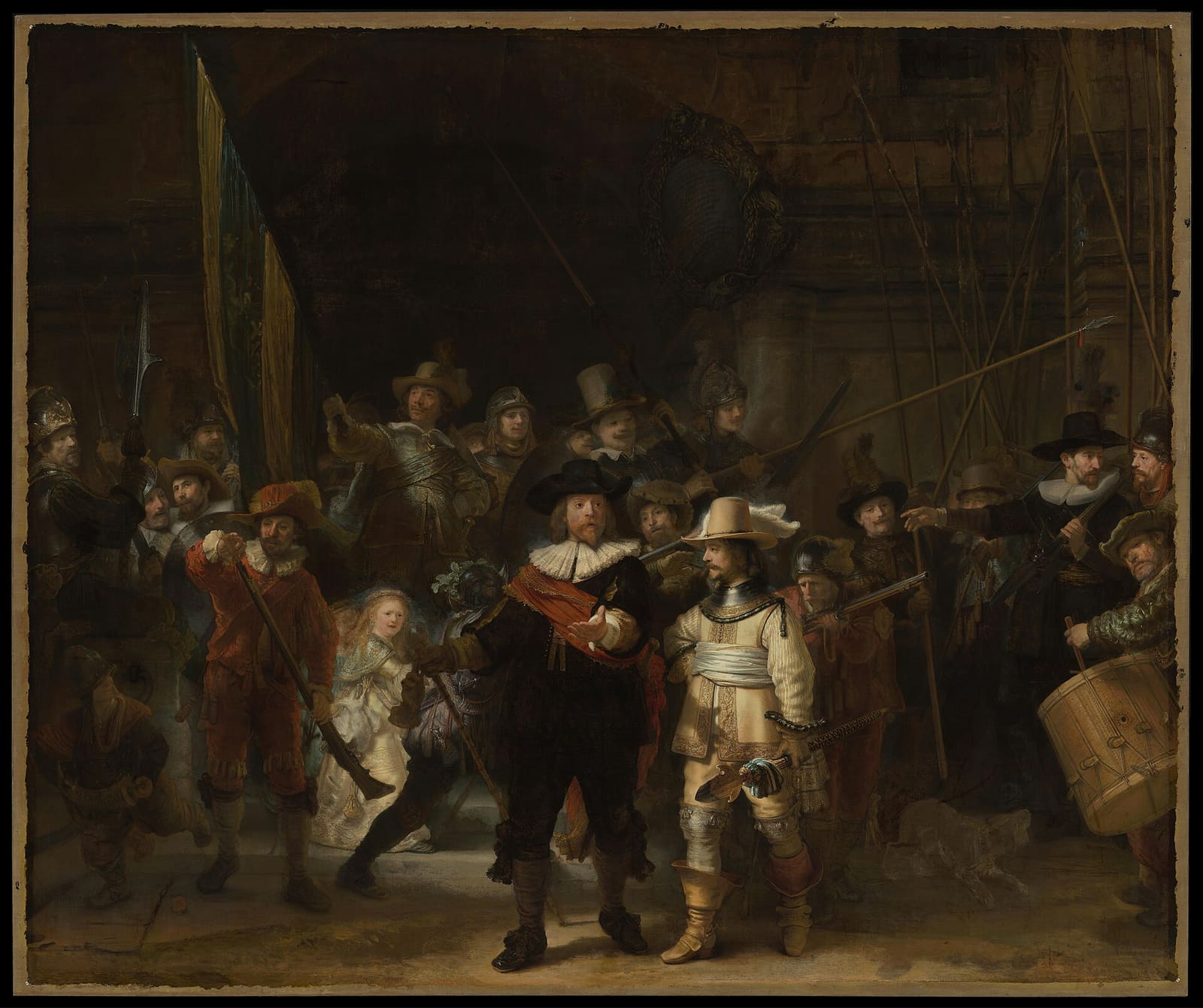
- Artist
- Rembrandt
- Date
- 1642
- Medium
- Oil on canvas
- Dimensions
- 379.5 × 453.5 cm
- Collection
- Rijksmuseum, Amsterdam
- Movement
- Baroque
- Medium guide
- Oil painting
What the painting shows
Its real subject is a company of Amsterdam’s civic militia, the citizen guards who defended the city and paraded on public occasions. The official title names its leaders: Militia Company of District II under the Command of Captain Frans Banninck Cocq. Cocq strides forward in black with a red sash, giving an order to his lieutenant, Willem van Ruytenburch, who is dressed in pale gold. Around them the company bursts into motion: a man loads his musket, another fires, a drummer beats, a banner is raised and a dog barks.
A group portrait that moves
The work was commissioned for the great hall of the Kloveniersdoelen, the headquarters of the arquebusiers’ guild, where it hung with other company portraits. Most militia portraits of the time lined their members up in neat rows, every face equally lit. Rembrandt turned the formula into a scene of action, with the figures emerging from a dark archway into shafts of light. Some members are partly hidden by others or by gestures, which has fed the long-lived but unfounded legend that the sitters hated the painting.
The strong contrast of light and shadow, the diagonal energy and the sense of a moment caught in progress are all hallmarks of the Baroque.
Why it isn’t a night scene
The title came later. Over the centuries the varnish darkened so much that by the late 18th century the painting was known as The Night Watch. Cleaning in the 20th century revealed that the company is stepping out in daylight, though the deep shadows Rembrandt painted remain.
Cut down in 1715
In 1715 the painting was moved to Amsterdam’s town hall. It was too big for its new wall, so strips were cut from all four sides, the widest from the left, removing two figures. The original composition is known from a smaller copy made by Gerrit Lundens before the cut, now in the National Gallery, London.
Attacks and restoration
The painting has survived several attacks, including a knife assault in 1975 and acid in 1990, each followed by careful restoration. During the Second World War it was rolled up and hidden outside Amsterdam. Since 2019 the Rijksmuseum has been studying and treating it in a glass chamber in full view of visitors, a project it calls Operation Night Watch.
Where to see it
The Night Watch hangs at the end of the Gallery of Honour in the Rijksmuseum, Amsterdam, the room built around it.
Frequently asked questions
Why is it called The Night Watch?
It wasn't Rembrandt's title. The nickname appeared long after his death, when layers of darkened varnish made the scene look like night. Cleaning showed it is set in daylight.
Where is The Night Watch?
In the Rijksmuseum in Amsterdam, where it is the centerpiece of the Gallery of Honour.
How big is The Night Watch?
About 3.8 × 4.5 meters (379.5 × 453.5 cm). It was even larger before 1715, when strips were cut from all four sides, most from the left, so it would fit a wall in Amsterdam's town hall.
Who is the girl in The Night Watch?
Nobody knows who modeled for her. She works as a living emblem of the company: the clawed chicken hanging from her belt refers to the claw that was the symbol of the arquebusiers, the musketeers' guild.