Artist · Norwegian
Edvard Munch: Life, Paintings and Legacy
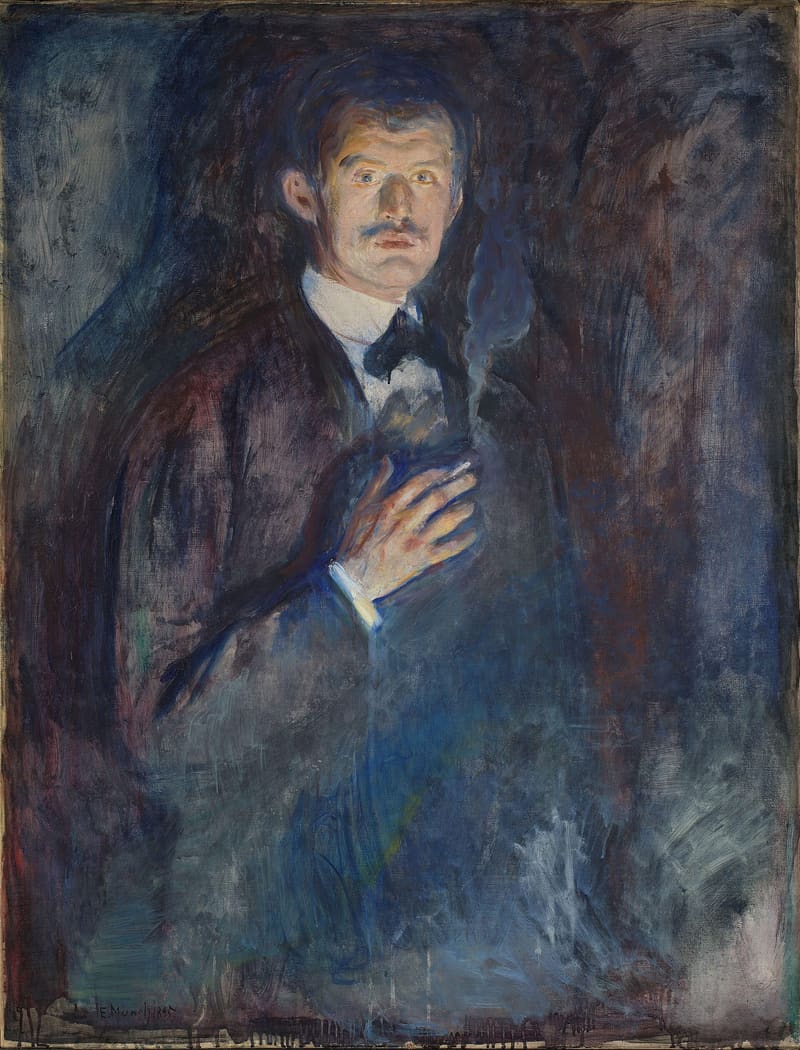
- Born
- December 12, 1863, Løten, Norway
- Died
- January 23, 1944, Ekely, Oslo, Norway
- Nationality
- Norwegian
- Movement
- Expressionism
- Mediums
- Oil painting
- Era
- 19th century
A childhood shadowed by death
Edvard Munch was born on 12 December 1863 in Løten, Norway, and grew up in Kristiania (now Oslo), the son of an army doctor. His mother died of tuberculosis when he was five, and his beloved older sister Sophie died of the same disease when he was 13. His father turned to an intense, anxious piety, and Munch himself was often ill. “Illness, insanity and death,” he later wrote, “were the black angels that kept watch over my cradle.” His painting The Sick Child (1885–1886), based on Sophie’s death, was attacked by critics for its rough, scraped surface.
Paris and Berlin
On study trips to Paris around 1889–1891 Munch saw the work of the Post-Impressionists, including Van Gogh and Gauguin, and of the Symbolists, which encouraged him to paint inner experience rather than outward appearances. In 1892 he was invited to exhibit in Berlin. His work caused such an outcry that the show was closed after a week. The “Munch affair” made him famous in Germany, and he spent much of the next 16 years there.
The Frieze of Life
In the 1890s Munch painted a series he called The Frieze of Life, “a poem of life, love and death.” It includes The Scream (1893), Madonna, Vampire, Anxiety, Jealousy and The Dance of Life. Faces become masks, bodies dissolve into swirling lines, and color carries raw feeling: blood-red skies, sickly greens, deep blues. He also became one of the great printmakers, using woodcuts and lithographs to repeat and vary his images.
Breakdown and later years
Drinking heavily and worn down by turbulent relationships, Munch had a nervous breakdown in 1908 and spent eight months in a clinic in Copenhagen. He then returned to Norway for good. His later painting is often brighter and more outward-looking, including the huge murals for the University of Oslo’s assembly hall (1909–1916). He lived alone at his estate at Ekely, outside Oslo, painting until the end. In 1937 the Nazis removed his works from German museums as “degenerate.” He died at Ekely on 23 January 1944, aged 80.
Legacy
Munch’s art was a direct inspiration for the German painters of Expressionism, and The Scream has become one of the most recognizable images in the world, an emblem of modern anxiety. He bequeathed his remaining work, more than 1,000 paintings and thousands of prints and drawings, to the city of Oslo, where it now forms the collection of the MUNCH museum.
Works by Edvard Munch
- The Scream · 1893
Frequently asked questions
How many versions of The Scream are there?
Munch made two painted versions (1893 and 1910), two pastels (1893 and 1895) and a lithograph (1895), from which he printed many impressions. The painted versions are in Oslo, at the National Museum and at the MUNCH museum.
Was Edvard Munch an Expressionist?
He is usually seen as a forerunner rather than a member. His paintings of the 1890s, using distorted form and strong color to express anxiety, love and death, directly inspired the German Expressionists of the 1900s.
Where can you see Munch's work?
In Oslo above all. Munch left his own vast collection of paintings, prints and drawings to the city, which is now shown at the MUNCH museum, and the National Museum holds many key works, including the 1893 Scream.