Artist · French
Paul Gauguin: Life, Paintings and Legacy
- Born
- June 7, 1848, Paris, France
- Died
- May 8, 1903, Atuona, Hiva Oa, Marquesas Islands
- Nationality
- French
- Movement
- Post-Impressionism
- Mediums
- Oil painting
- Era
- 19th century
From stockbroker to painter
Paul Gauguin was born in Paris on 7 June 1848 and spent his early childhood in Lima, Peru, with his mother’s family. After years as a merchant sailor and in the French navy, he became a successful stockbroker in Paris, married a Danish woman, Mette Gad, and had five children. He painted on Sundays and collected Impressionist pictures; through Camille Pissarro he showed with the Impressionists from 1880 to 1886. After the stock market crash of 1882, he decided to paint full time, and his family life fell apart.
Brittany and a new style
From 1886 Gauguin worked in Pont-Aven in Brittany, drawn by cheap living and the local Breton traditions. With the younger painter Émile Bernard he developed a style of flat areas of strong color inside dark outlines, inspired by stained glass, folk art and Japanese prints. Vision After the Sermon (1888), in the Scottish National Gallery, shows Breton women in white caps seeing Jacob wrestle the angel on a field of pure red.
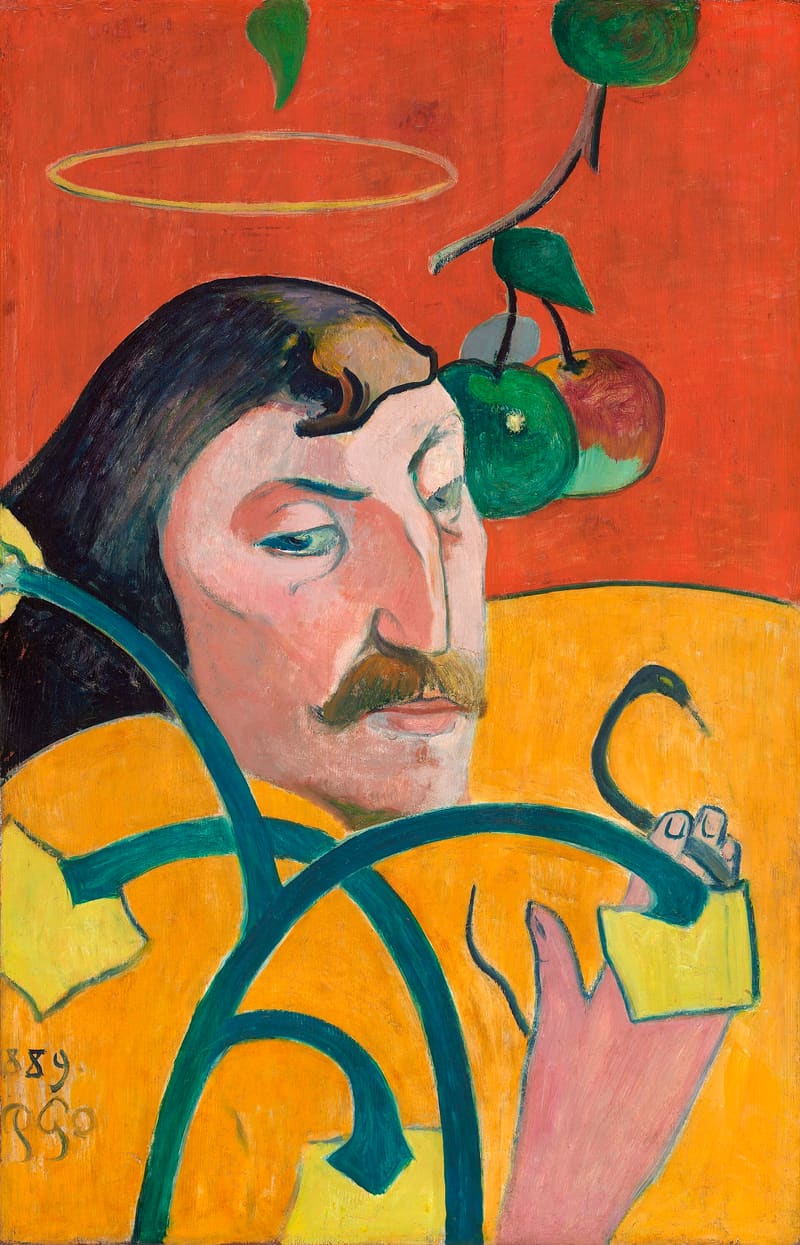
The self-portrait shown above, painted in 1889 on a cupboard door at an inn at Le Pouldu, casts the artist as both saint and sinner, with a halo, apples and a snake.
Arles with Van Gogh
In October 1888 Gauguin joined Vincent van Gogh in Arles, where Van Gogh dreamed of founding a “Studio of the South.” For nine weeks they painted side by side and argued fiercely about art. The experiment ended on 23 December, when Van Gogh, in crisis, cut off part of his ear. Gauguin left the next day.
Tahiti and the Marquesas
In 1891 Gauguin sailed for Tahiti, hoping to find an unspoiled paradise. He painted Tahitian women and landscapes in rich, flat color and gave his pictures mysterious titles in Tahitian. Back in Paris in 1893 his exhibition failed to sell, and in 1895 he left Europe for good. In Tahiti, ill and in debt, he painted his largest work, Where Do We Come From? What Are We? Where Are We Going? (1897–1898), now in the Museum of Fine Arts, Boston. In 1901 he moved to the remote Marquesas Islands, where he quarreled with the colonial authorities and the church. He died at Atuona, on the island of Hiva Oa, on 8 May 1903, aged 54.
Legacy
Gauguin’s flat, symbolic, non-natural color was a major source for the Nabis, for Matisse and the Fauves, and for German Expressionism, and his interest in non-European art anticipated Picasso’s. He is one of the four central figures of Post-Impressionism. His reputation is also contested: his abandonment of his family and his relationships with very young Polynesian girls are now discussed openly alongside his art, and museums increasingly present his Tahitian paintings in the light of the colonial world in which he made them.
Frequently asked questions
Why did Gauguin go to Tahiti?
He wanted to escape what he saw as the artificial, money-driven civilization of Europe and find a simpler, 'primitive' life and new subjects. The Tahiti he found in 1891 was already a French colony much changed by missionaries and settlers.
What happened between Gauguin and Van Gogh?
Gauguin spent nine weeks with Van Gogh in Arles in late 1888. Their arguments ended on 23 December, when Van Gogh, in a mental crisis, cut off part of his own ear. Gauguin left for Paris, and the two never met again, though they kept writing to each other.
Why is Gauguin controversial today?
He abandoned his wife and five children, and in Polynesia he took girls as young as 13 as sexual partners. Museums now present his work alongside this history and the colonial setting in which he painted.