Art movement · c. 1905–1908
Fauvism: History, Artists and Key Works
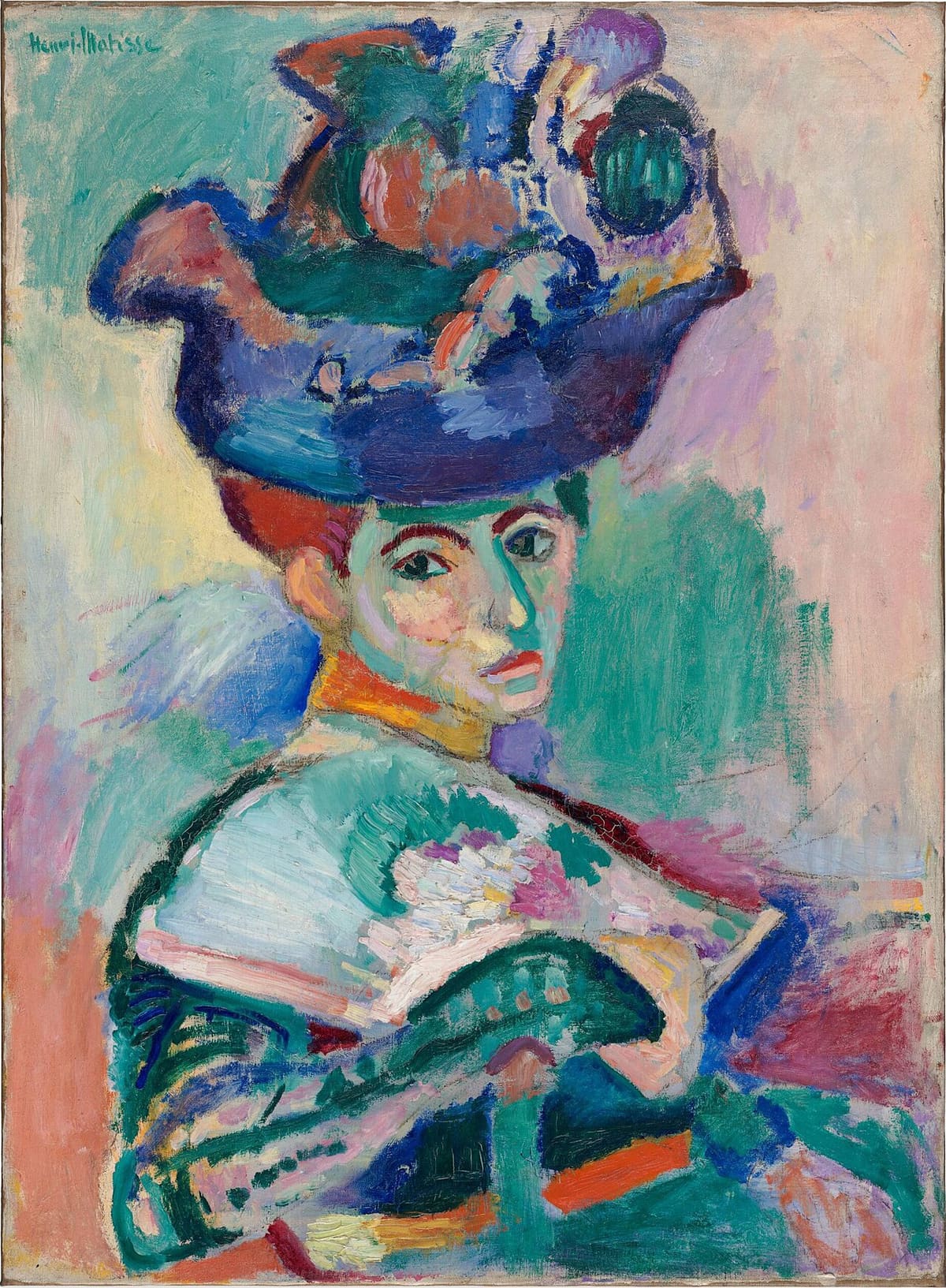
What is Fauvism?
Fauvism was a short-lived but explosive movement in French painting, led by Henri Matisse, in which color was set free from describing the world. A face could be green, a tree red, a sea pink. The Fauves used pure, intense color straight from the tube, in broad, loose strokes, not because things looked that way but to express feeling and to build the picture.
It is often called the first avant-garde movement of the 20th century.
Origins: the summer of 1905
Fauvism grew directly out of Post-Impressionism: the emotional color of Van Gogh, the flat, symbolic color of Gauguin, and the pure dots of Seurat and Signac, with whom Matisse had painted in 1904. In the summer of 1905 Matisse and the younger André Derain worked together in the Mediterranean fishing port of Collioure, painting harbor views and portraits in blazing, unmixed color.
That autumn they showed the results at the Salon d’Automne in Paris, hung together in one room with work by Maurice de Vlaminck and others. The public laughed and critics were outraged. Matisse’s portrait of his wife Amélie, Woman with a Hat, shown above, was singled out for mockery. It was bought by the American collectors Leo and Gertrude Stein.
Where the name came from
In the middle of the room stood a small, conventional sculpture in Renaissance style. The critic Louis Vauxcelles, seeing it surrounded by the paintings, quipped “Donatello parmi les fauves!” (“Donatello among the wild beasts!”). Like “Impressionist” before it, the insult became the movement’s name.
Key artists
Henri Matisse
The movement’s leader. In paintings such as Woman with a Hat and The Joy of Life (1905–1906) he used color for its own power and harmony. He wanted, he later wrote, an art of balance and serenity, “something like a good armchair.”
André Derain
Derain painted Collioure with Matisse in 1905 and, the following year, a series of London views commissioned by the dealer Ambroise Vollard, turning the Thames into ribbons of yellow, blue and green.
Maurice de Vlaminck
A self-taught painter, racing cyclist and violinist, Vlaminck was the wildest of the group. He claimed he wanted to burn down the École des Beaux-Arts with his cobalts and vermilions, and painted with thick, violent strokes in the manner of Van Gogh.
Key characteristics
Arbitrary, intense color
Color chosen for emotion and design, not for accuracy.
Loose, visible brushwork
Broad strokes and patches of paint, often with bare canvas showing between them.
Simplified forms
Flattened space and simple shapes, with little traditional modeling or perspective.
What came next
By 1908 the Fauves had gone their separate ways. Georges Braque, who had painted Fauve landscapes, turned to the structured approach of Cézanne and, with Picasso, invented Cubism. In Germany the young painters of Expressionism took up the Fauves’ violent color for darker, more anguished ends. Matisse himself kept refining his use of pure color for another half-century, ending with his paper cut-outs in the 1940s and 1950s.
Major Fauvist artists
- Henri Matisse · 1869–1954
Before and after Fauvism
- Came before: Post-Impressionism (c. 1886–1905)
- Came after: Expressionism (c. 1905–1925)
- Came after: Cubism (c. 1907–1914)
Mediums and era
- Medium: Oil painting
Frequently asked questions
What does Fauvism mean?
It comes from les fauves, French for 'the wild beasts'. The critic Louis Vauxcelles used the phrase at the 1905 Salon d'Automne, where a conventional sculpture stood in a room of violently colored paintings: 'Donatello among the wild beasts!'
Who were the main Fauvist painters?
Henri Matisse, the group's leader, André Derain and Maurice de Vlaminck. Albert Marquet, Henri Manguin, Raoul Dufy, Kees van Dongen and, briefly, Georges Braque also painted in the style.
How long did Fauvism last?
Only about three years, from 1905 to around 1908. It was never a formal group, and its painters soon moved in different directions; Braque, for one, went on to invent Cubism with Picasso.