Artist · French
Henri Matisse: Life, Paintings and Legacy
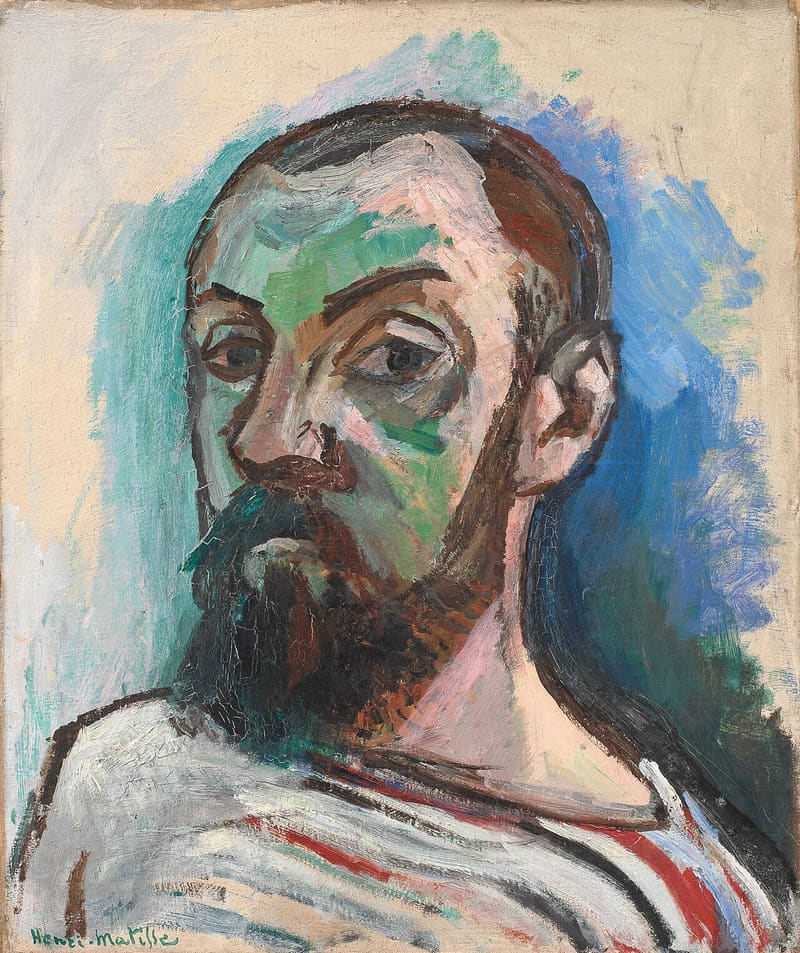
- Born
- December 31, 1869, Le Cateau-Cambrésis, France
- Died
- November 3, 1954, Nice, France
- Nationality
- French
- Movement
- Fauvism
- Mediums
- Oil painting
A late start
Henri Matisse was born on 31 December 1869 in Le Cateau-Cambrésis, in northern France, and grew up in nearby Bohain, where his father was a grain merchant. He trained as a lawyer’s clerk. In 1889, while he was recovering from appendicitis, his mother gave him a box of paints, and he later said it was like discovering “a kind of paradise.” He gave up law and went to Paris, where he studied with the Symbolist painter Gustave Moreau.
Finding color
His early pictures were dark and traditional. During the 1890s he discovered the Impressionists and, above all, Paul Cézanne, buying a small Cézanne painting of bathers that he kept for decades, even when he could barely afford it. In the summer of 1904 he painted with Paul Signac in Saint-Tropez, experimenting with dots of pure color.
The wild beast
In 1905 Matisse and André Derain painted together in the Mediterranean port of Collioure. That autumn, their blazing canvases at the Salon d’Automne earned them the name les fauves, “the wild beasts,” and made Matisse, at 35, the leader of the avant-garde (see Fauvism). The self-portrait shown above dates from the following year. Wealthy collectors began to support him, among them Leo and Gertrude Stein and the Russian merchant Sergei Shchukin, who commissioned the huge paintings Dance and Music (1910), now in the Hermitage in St. Petersburg.
Nice and the search for calm
Matisse wanted, as he wrote in 1908, “an art of balance, of purity and serenity,” something like “a good armchair” for the tired mind. From 1917 he spent most of his time in Nice, painting sunny interiors, open windows and odalisques among patterned fabrics. Throughout his life he kept up an intense rivalry and friendship with Picasso.
The cut-outs
In 1941 Matisse had major surgery for cancer and was left largely confined to a bed or wheelchair. Rather than stop, he invented a new art: he cut shapes from sheets of paper painted with gouache and had them pinned to the walls, “drawing with scissors.” The cut-outs, including the book Jazz (1947) and The Snail (1953), are some of his most joyful works. He also designed the Chapel of the Rosary in Vence (1948–1951), from its stained glass to the priests’ robes. He died in Nice on 3 November 1954, aged 84.
Legacy
Matisse freed color from describing the world and showed that it could carry emotion and structure a picture on its own. Along with Picasso, he is generally regarded as one of the two most important artists of the early 20th century.
Frequently asked questions
Why is Henri Matisse famous?
For his revolutionary use of color. He led the Fauves, whose wild, non-natural color shocked Paris in 1905, and over half a century he made color, line and pattern the real subjects of painting, ending with his bright paper cut-outs.
What are Matisse's cut-outs?
Works made from paper that assistants painted with gouache and Matisse cut into shapes with scissors and arranged on the wall. He turned to the technique in the 1940s, when illness made painting at an easel difficult. Famous examples include the book Jazz (1947) and The Snail (1953).
Were Matisse and Picasso rivals?
Yes, and friends. They met in 1906 at the apartment of Gertrude Stein and spent the next half-century watching, challenging and learning from each other. Picasso said that nobody had looked at his painting more carefully than Matisse, and nobody had looked at Matisse's more carefully than he had.