Artist · French
Jean-François Millet: Life, Paintings and Legacy
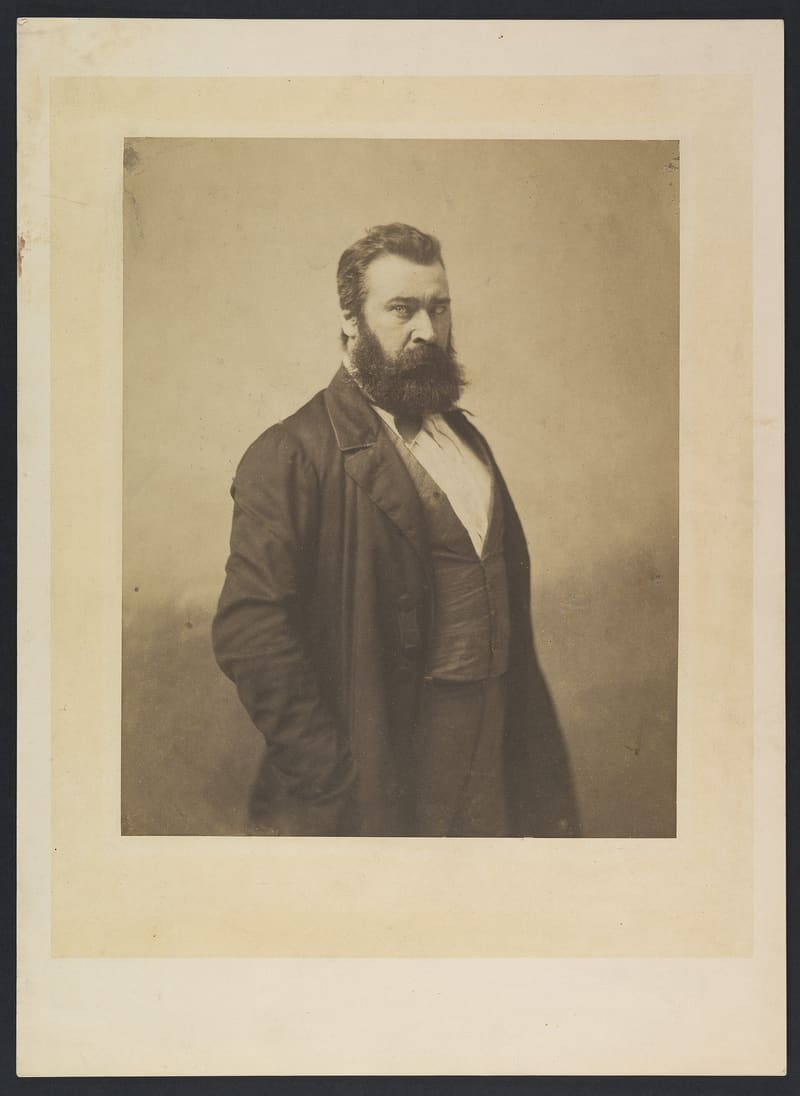
- Born
- October 4, 1814, Gruchy, Normandy, France
- Died
- January 20, 1875, Barbizon, France
- Nationality
- French
- Movement
- Realism
- Mediums
- Oil painting
- Era
- 19th century
A farmer’s son
Jean-François Millet was born on 4 October 1814 in the hamlet of Gruchy, near Cherbourg in Normandy, the eldest son of a farming family. He worked on the land as a boy, and his family, who were devout and well-read for their station, encouraged his talent. After training with local painters in Cherbourg, he won a grant from the town to study in Paris in 1837, in the studio of the history painter Paul Delaroche.
Struggle in Paris
For more than a decade Millet scraped a living with portraits and small, pretty pastoral and mythological scenes in the fashionable manner. His first wife died young, and he lived with his second partner, Catherine Lemaire, and a growing family in poverty. In 1848, the year of revolution in France, his Winnower, a peasant tossing grain in a barn, was a success at the Salon.
Barbizon and peasant life
In 1849 Millet moved with his family to the village of Barbizon, on the edge of the Forest of Fontainebleau, where other painters had settled to work from nature. He stayed for the rest of his life and devoted himself to the people of the fields: sowers, reapers, shepherds, women spinning or churning butter. The Sower (1850) strides down a hillside flinging seed. The Gleaners (1857) shows three women stooping to gather the stray stalks left after the harvest. The Angelus (1857–1859) shows a couple pausing in a potato field to pray as a distant church bell rings.
He painted these figures with a monumental weight, simplifying their forms like sculpture. To conservative critics, at a time of political upheaval, the sight of poor laborers on the scale of history painting looked like a threat; Millet insisted he was showing the dignity of work, not making a political statement. With Gustave Courbet he became a central figure of Realism.
Recognition
Success came late. In the 1860s Millet’s work began to sell, and at the Paris Exposition Universelle of 1867 he was awarded a first-class medal. He was made a knight of the Legion of Honor in 1868. He died at Barbizon on 20 January 1875, aged 60.
Legacy
After his death, The Angelus became one of the most famous paintings in the world, fought over by French and American buyers, and reproduced endlessly in prints. Millet’s influence on later painters was profound, above all on Vincent van Gogh, who called him a guide and copied his compositions again and again, and also on Camille Pissarro, Georges Seurat and Salvador Dalí, who was obsessed with The Angelus.
Works by Jean-François Millet
- The Gleaners · 1857
Frequently asked questions
What is Jean-François Millet famous for?
For dignified paintings of French peasants at work, especially The Sower (1850), The Gleaners (1857) and The Angelus (1857–1859). The last two are in the Musée d'Orsay in Paris.
What is the Barbizon school?
A group of French painters who worked in and around the village of Barbizon, on the edge of the Forest of Fontainebleau, from the 1830s onward, painting landscape and rural life directly from nature. Millet lived there from 1849 until his death.
How did Millet influence Van Gogh?
Deeply. Van Gogh revered Millet as a painter of peasants, and in 1889–1890, at the asylum in Saint-Rémy, he made more than 20 painted copies after Millet's prints and drawings, translated into his own color.