Artwork · 1857
The Gleaners by Jean-François Millet: Meaning and History
- Artist
- Jean-François Millet
- Date
- 1857
- Medium
- Oil on canvas
- Dimensions
- 83.5 × 110 cm
- Collection
- Musée d'Orsay, Paris
- Movement
- Realism
- Medium guide
- Oil painting
What the painting shows
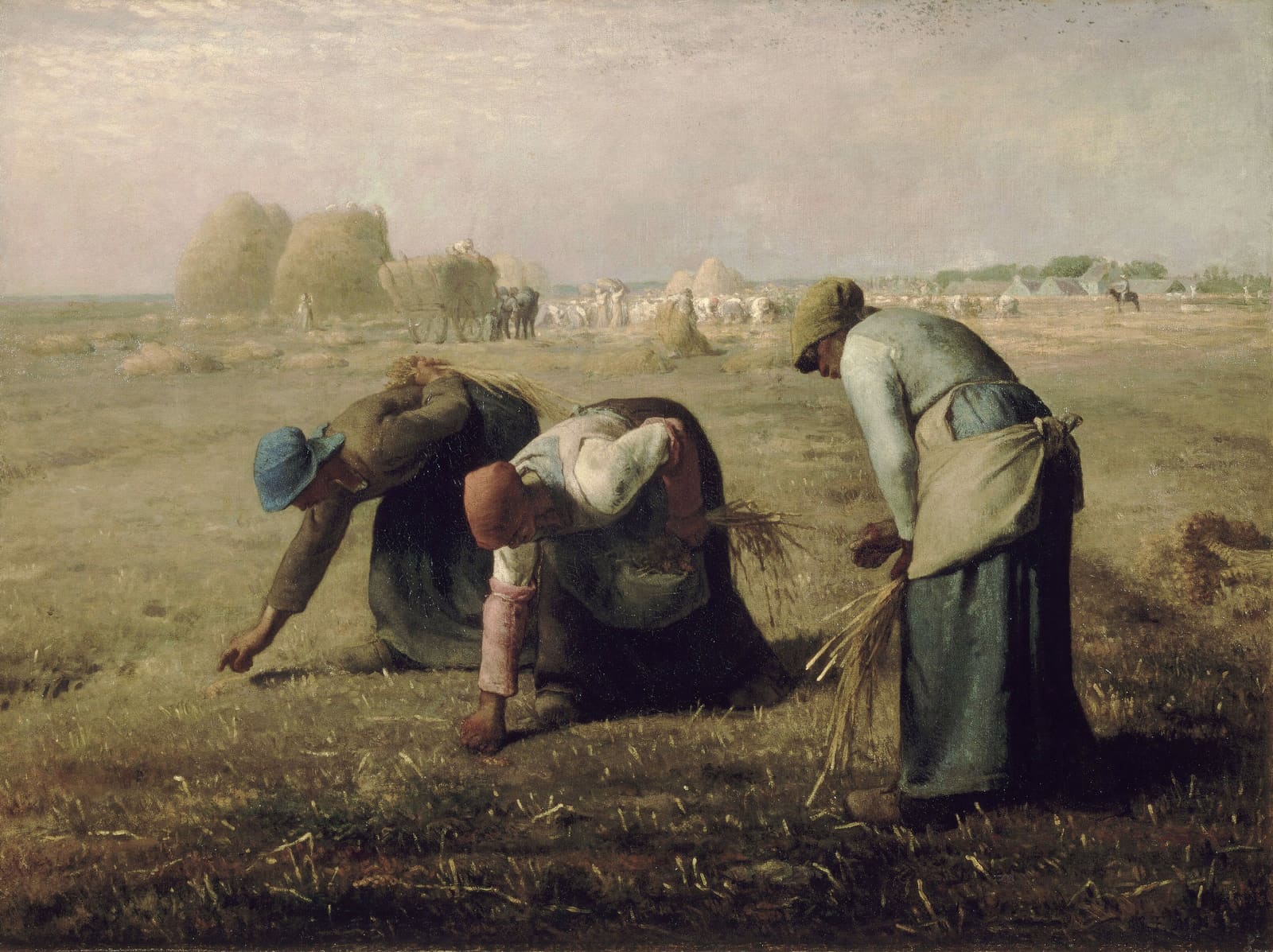
Three peasant women work across a flat, stubbled field in the late afternoon. Two bend double to pick up stray stalks of wheat; the third, half-straightening, rests her back. Their faces are hidden and their hands are rough; their clothes are patched but their colors, red, blue and ochre, glow in the low sun.
Behind them, in the distance, is another world: huge haystacks, a loaded cart, a crowd of harvesters and, on horseback, an overseer keeping watch over the estate. The bounty belongs to others. The three women are left to collect what has fallen.
What gleaning was
Gleaning was an ancient custom, described in the Bible’s Book of Ruth: after the harvest, the poorest people of a village were allowed into the fields to gather leftover grain. In 19th-century France it was strictly regulated, limited to set hours and to those with nothing else. It was some of the hardest and least rewarded work in the countryside.
How Millet painted it
Millet, himself the son of Normandy farmers, lived at Barbizon on the edge of the Forest of Fontainebleau and made many drawings and etchings of gleaners before this painting. He gave the women a sculptural weight and simplicity, setting them low on the canvas against a high horizon so that they seem rooted in the earth, and arranged them in a slow rhythm, like a frieze on an ancient temple.
The 1857 Salon
When The Gleaners appeared at the Salon of 1857, conservative critics were alarmed. Painting the rural poor on a scale normally reserved for history and religion seemed, so soon after the revolution of 1848, like a protest or a threat. One critic called the women the “three Fates of pauperism.” Supporters saw dignity and solemn beauty. Millet insisted he was not making a political statement, only showing the people he knew. With Courbet he became a central figure of Realism.
Where to see it
The painting sold for a modest sum after the Salon, but its fame grew, and in 1889 Jeanne-Alexandrine Pommery, head of the Champagne house, paid a very large price for it. She bequeathed it to the Louvre in 1890. It now hangs in the Musée d’Orsay in Paris, near Millet’s The Angelus.
Frequently asked questions
What is gleaning?
Gathering the stalks of grain left in a field after the harvest. In France it was an ancient right of the very poorest villagers, usually women, who were allowed into the fields only once the harvest had been carried away.
Where is The Gleaners?
In the Musée d'Orsay in Paris. It was bequeathed to the Louvre in 1890 by Jeanne-Alexandrine Pommery, head of the Champagne house, who had bought it the year before.
Why was The Gleaners controversial?
Less than a decade after the revolution of 1848, critics feared that showing the rural poor on a large scale, with the dignity of history painting, was a political statement. One called the women the 'three Fates of pauperism'. Millet said he was simply painting the people he knew.