Artist · Austrian
Gustav Klimt: Life, Paintings and Legacy
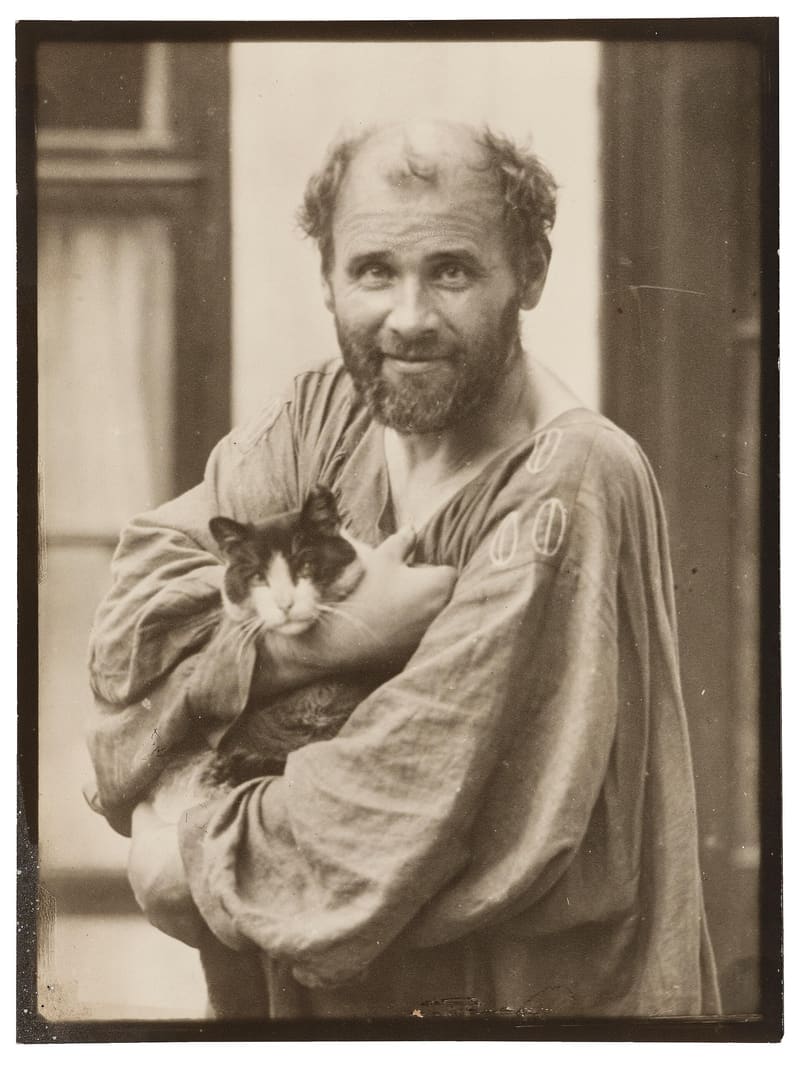
- Born
- July 14, 1862, Baumgarten, near Vienna, Austria
- Died
- February 6, 1918, Vienna, Austria
- Nationality
- Austrian
- Movement
- Art Nouveau
- Mediums
- Oil painting
Early life and training
Gustav Klimt was born on 14 July 1862 in Baumgarten, a village on the edge of Vienna, the second of seven children of a gold engraver. He trained at the Vienna School of Arts and Crafts and in 1883 set up a decorating firm with his brother Ernst and their friend Franz Matsch. The three young men painted ceilings and murals for the theaters and museums of Vienna’s grand new Ringstrasse, including the Burgtheater and the staircase of the Kunsthistorisches Museum, in a polished academic style.
The Vienna Secession
In the 1890s Klimt turned away from academic painting. In 1897 he led a group of artists out of Vienna’s official artists’ association to found the Vienna Secession, and became its first president. The Secession built its own exhibition hall, crowned by a dome of gilded laurel leaves, and showed modern art from across Europe. It was the Viennese branch of Art Nouveau, and it aimed to unite painting, architecture and design. Klimt’s Beethoven Frieze (1902) was painted for one of its exhibitions.
The university scandal
In 1894 Klimt was commissioned to paint three large ceiling panels for the University of Vienna, representing Philosophy, Medicine and Jurisprudence. Instead of celebrating reason, he painted floating, naked bodies adrift in a dark void. Professors protested and the paintings were attacked in parliament. In 1905 Klimt returned his fee and took the paintings back. All three were destroyed by fire in 1945, at the end of the Second World War.
The golden phase
After a trip to Ravenna in 1903, where he saw glittering Byzantine mosaics, Klimt began to use gold leaf lavishly. In his “golden phase” he painted Portrait of Adele Bloch-Bauer I (1907), now in the Neue Galerie in New York, and The Kiss (1907–1908), now in the Belvedere in Vienna. Realistic faces and hands emerge from flat, jewel-like patterns of gold and color.
Later work and legacy
Klimt also painted serene, square-format landscapes, many at Lake Attersee, where he spent summers with his lifelong companion, the fashion designer Emilie Flöge. He encouraged younger artists, above all Egon Schiele, a leading figure of Austrian Expressionism. He died in Vienna on 6 February 1918 after a stroke, aged 55. Today he is Austria’s most famous painter, and his golden works are among the most reproduced images of the period.
Works by Gustav Klimt
- The Kiss · 1907–1908
Frequently asked questions
What is Gustav Klimt's most famous painting?
The Kiss (1907–1908), showing a couple embracing in robes of gold, on a flowered meadow at the edge of a cliff. It hangs in the Belvedere in Vienna.
Did Klimt use real gold?
Yes. In his 'golden phase', around 1903–1909, he applied gold and silver leaf to his paintings, inspired partly by the Byzantine mosaics he saw in Ravenna. His father was a gold engraver.
What was the Vienna Secession?
A group of artists, led by Klimt as its first president, who broke away from Vienna's conservative artists' association in 1897 to show modern and international art. Its motto, over the door of its exhibition building, reads: 'To every age its art, to art its freedom'.