Art movement · c. 1890–1910
Art Nouveau: History, Artists and Key Works
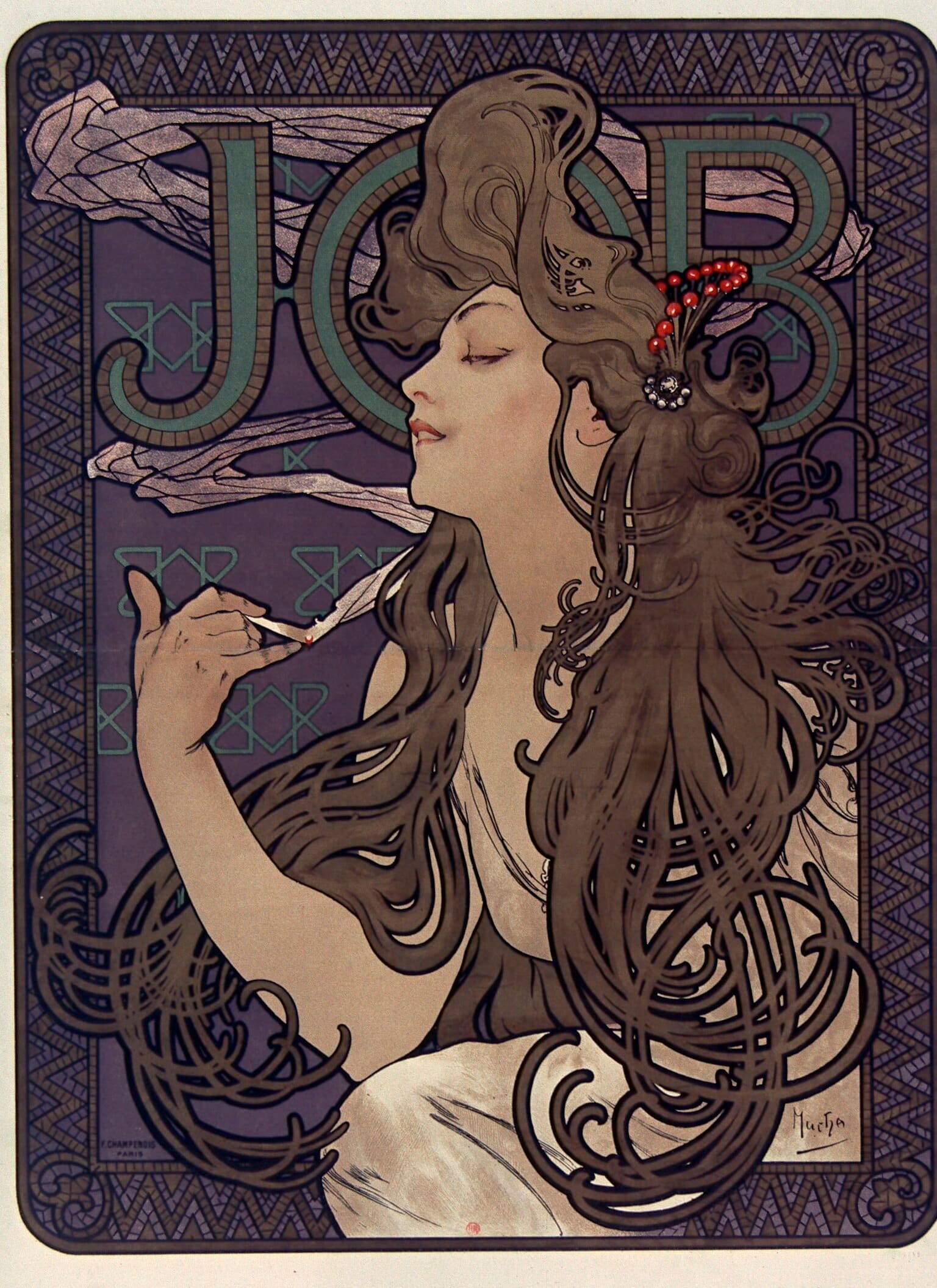
What is Art Nouveau?
Art Nouveau, French for “new art,” was an international style of design, architecture and art that flourished from about 1890 until the First World War. Its designers rejected the habit of copying historical styles that dominated the 19th century and looked to nature instead: the curve of a lily stem, a dragonfly’s wing, a woman’s flowing hair.
It was a style of everyday things as much as of paintings. Its makers believed there should be no barrier between fine art and craft, and that a building, its furniture, its door handles and its wallpaper could all be designed as one harmonious work of art.
Origins
Art Nouveau grew out of the British Arts and Crafts Movement led by William Morris, the dreamy art of the later Pre-Raphaelites, Symbolist painting, and the Japanese prints that flooded into Europe from the 1860s, with their flat color and elegant outline. The name comes from the Maison de l’Art Nouveau, a gallery the dealer Siegfried Bing opened in Paris in 1895. The style reached its height at the Paris Exposition Universelle of 1900.
One style, many names
Art Nouveau spread fast, and each country gave it a name of its own: Jugendstil (“youth style”) in Germany, after the magazine Jugend; Sezessionsstil in Vienna, after the Secession artists’ group; Modernisme in Catalonia; and Stile Liberty in Italy, after the London department store Liberty, which sold the style.
Key artists and designers
Alphonse Mucha
The Czech artist Alphonse Mucha became famous almost overnight in January 1895, when his poster for the actress Sarah Bernhardt in the play Gismonda appeared on the walls of Paris. His posters, like the one for Job cigarette papers shown above, define the style’s look: idealized women framed by swirling hair, flowers and decorative halos.
Victor Horta and Hector Guimard
In Brussels the architect Victor Horta designed the Hôtel Tassel (1893), whose iron columns and staircase curl like plant stems. In Paris Hector Guimard designed the green cast-iron entrances to the Métro, from 1900, some of which still stand.
Antoni Gaudí
In Barcelona, Gaudí took organic form further than anyone, in buildings such as the Casa Batlló and the still-unfinished basilica of the Sagrada Família.
Gustav Klimt and the Vienna Secession
In 1897 Klimt led a group of artists out of Vienna’s official academy to form the Secession. His gold-encrusted paintings, such as The Kiss (1907–1908), are the movement’s most famous pictures.
Tiffany Studios and the glassmakers
In France, Émile Gallé and the glassmakers of Nancy, and the jeweler René Lalique, turned glass and jewelry into Art Nouveau sculpture. In New York, Louis Comfort Tiffany’s studios produced leaded-glass windows and lamps in shimmering opalescent glass. Research in recent decades has shown that many of the famous floral lamps were designed by Clara Driscoll and the women of the studio’s glass-cutting department; you can read about that discovery on our About page.
Key characteristics
The whiplash line
Long, sinuous S-curves that seem to move and grow.
Nature as a source
Plants, flowers, insects, peacock feathers and flowing hair, stylized into ornament.
A total work of art
Architecture, interiors, furniture, glass, jewelry, posters and books, designed as a single whole.
Decline and legacy
By about 1910 the style was seen as overdone, and the First World War ended it. In the 1920s the geometric, machine-inspired Art Deco took its place. Art Nouveau was dismissed for decades as decadent kitsch, until a revival in the 1960s, when its posters and curves inspired psychedelic design. Today its buildings are protected landmarks, and Tiffany lamps and Mucha posters are among the most sought-after objects of their age.
Major Art Nouveau artists
- Alphonse Mucha · 1860–1939
- Gustav Klimt · 1862–1918
Famous Art Nouveau works
- The Kiss · 1907–1908
Before and after Art Nouveau
- Came before: The Pre-Raphaelites (c. 1848–1900)
Mediums and era
- Era: 19th century
Frequently asked questions
Where does the name Art Nouveau come from?
From the Maison de l'Art Nouveau ('House of the New Art'), a gallery and shop that the dealer Siegfried Bing opened in Paris in 1895 to sell modern design.
What are the main features of Art Nouveau?
Long, flowing, organic lines (often called the whiplash curve), motifs from plants, flowers, insects and women's hair, and the belief that everything from a building to a spoon should be designed as a work of art.
What is the difference between Art Nouveau and Art Deco?
Art Nouveau (c. 1890–1910) is curving and organic, inspired by nature. Art Deco, which followed in the 1920s and 1930s, is geometric and streamlined, inspired by machines and modern speed.
Is Tiffany glass Art Nouveau?
Yes. The leaded-glass lamps and windows of Tiffany Studios in New York, with their dragonflies, wisteria and peonies, are among the best-known American examples. Many of the famous floral lamp designs are now credited to Clara Driscoll, who headed the studio's Women's Glass Cutting Department.