Artwork · 1907–1908
The Kiss by Gustav Klimt: Gold, Pattern and Meaning
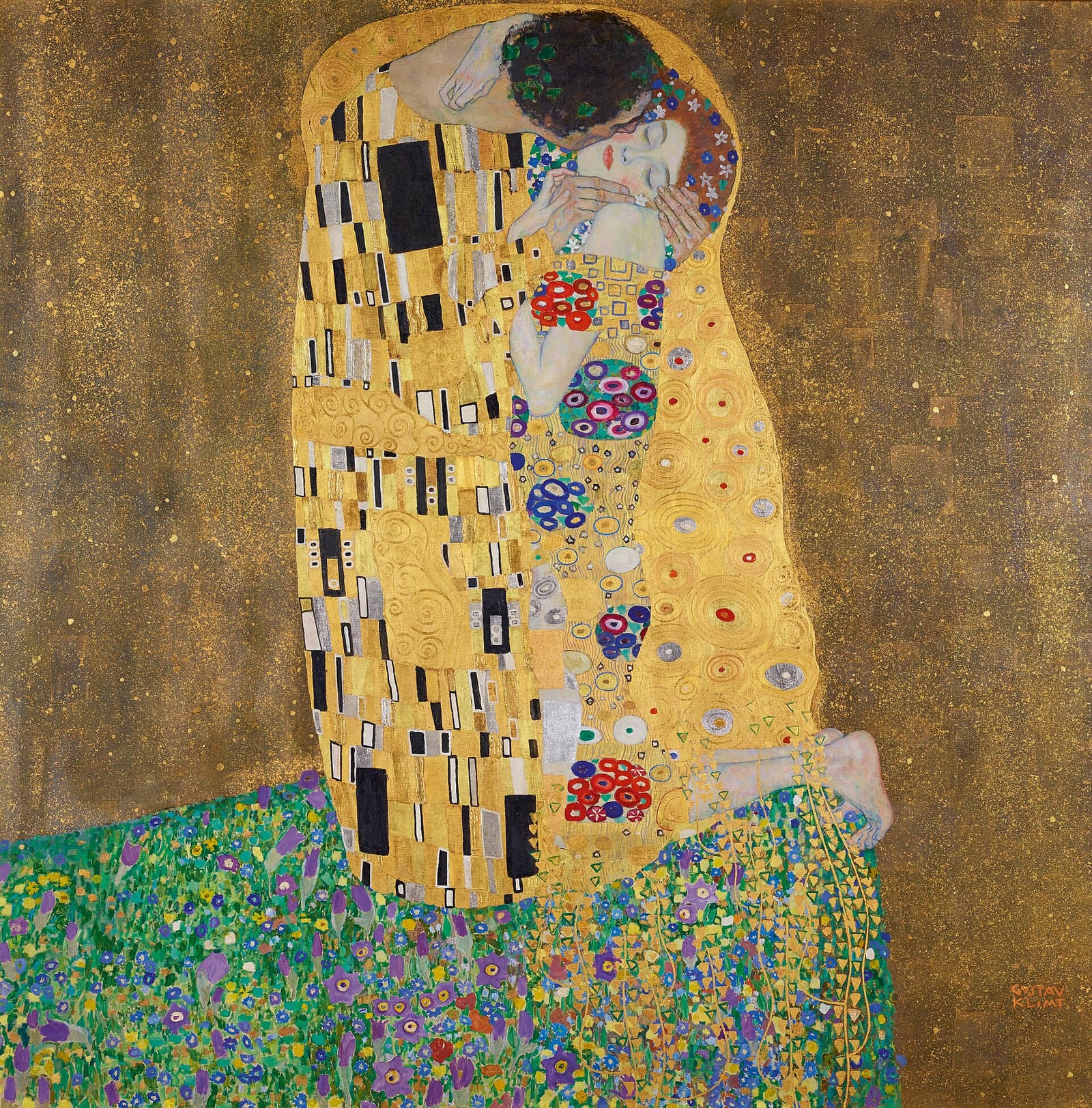
- Artist
- Gustav Klimt
- Date
- 1907–1908
- Medium
- Oil and gold leaf on canvas
- Dimensions
- 180 × 180 cm
- Collection
- Belvedere, Vienna
- Movement
- Art Nouveau
- Medium guide
- Oil painting
What the painting shows
A man and a woman embrace on a narrow strip of flowered meadow that ends abruptly at the edge of a cliff. He bends his head over hers and holds her face in his hands; she kneels, eyes closed, one arm around his neck, her bare feet curled at the very brink. They are wrapped together in a single glittering golden robe, set against a background of shimmering gold dust.
Only their faces, hands and her feet are painted realistically. Everything else dissolves into flat ornament.
The patterns
Look closely at the robes. His is covered in black, white and gray rectangles; hers in circles and flowers of red, blue and violet. Writers have often read the rectangles and circles as male and female signs, joined within a single golden shape. The square canvas, about 1.8 meters on each side, adds to the sense of balance and stillness.
Gold and Byzantium
The Kiss is the high point of Gustav Klimt’s “golden phase.” After seeing the gold-ground Byzantine mosaics of Ravenna in 1903, he began to use real gold leaf in his paintings. Klimt was the son of a gold engraver and had trained as a decorator, and in his hands painting moved close to the decorative arts, metalwork and mosaic. That fusion of fine art and design is central to Vienna’s version of Art Nouveau.
Bought straight off the wall
Klimt first showed The Kiss, under the title The Lovers, at the Kunstschau, an exhibition he organized in Vienna in 1908. Even though some of his work had caused scandals, the Austrian Ministry of Education bought the painting during the exhibition, reportedly before Klimt considered it finished. It has belonged to the Belvedere ever since.
Where to see it
The Kiss hangs in the Upper Belvedere in Vienna, alongside the world’s largest collection of Klimt’s paintings. It is one of the most visited works of art in Austria and one of the most reproduced images of the early 20th century.
Frequently asked questions
Where is The Kiss by Klimt?
In the Upper Belvedere palace in Vienna, Austria. The Austrian state bought it in 1908, at the exhibition where it was first shown, and it has belonged to the Belvedere ever since.
Is there real gold in The Kiss?
Yes. Klimt applied gold leaf, along with silver and platinum, over oil paint. The painting is the high point of his 'golden phase', inspired partly by the Byzantine mosaics he saw in Ravenna.
Who are the couple in The Kiss?
Nobody knows. It has often been suggested that they are Klimt and his companion Emilie Flöge, but there is no evidence. The faces are idealized, and the couple can be read as an image of love in general.